
Energy-Saving Renovation Upgrades Payback
Energy-saving renovation upgrades can produce reliable payback, and Riley Riley Construction models expected savings against upfront costs to show real ROI. We analyze insulation, HVAC, windows, and efficient appliances to prioritize measures with the fastest returns. Contact Riley Riley Construction at 17209155352 for a customized payback analysis that aligns improvements with long-term savings. Data-driven choices maximize comfort while lowering ongoing energy expenses.
Why model-based payback matters for renovation decisions
Making home or building improvements without clear numbers often leads to missed opportunities and slow or negative returns. Modeling expected savings against upfront costs gives property owners a realistic view of cash flow, cost recovery, and long-term value. An evidence-based approach reduces risk, establishes priorities, and ensures that energy investments produce measurable and verifiable results rather than relying on vendor estimates or rule-of-thumb assumptions.
Modeling also helps compare competing upgrades on a common basis: dollars saved per year, simple payback periods, and lifecycle returns. When you know whether an upgrade will pay back in 2 years or 20 years, you can align work with your budget, timeline, and sustainability goals. This clarity is particularly important when combining measures like insulation, HVAC replacement, window upgrades, and efficient appliances into a comprehensive plan.
How Riley Riley Construction builds a reliable ROI model
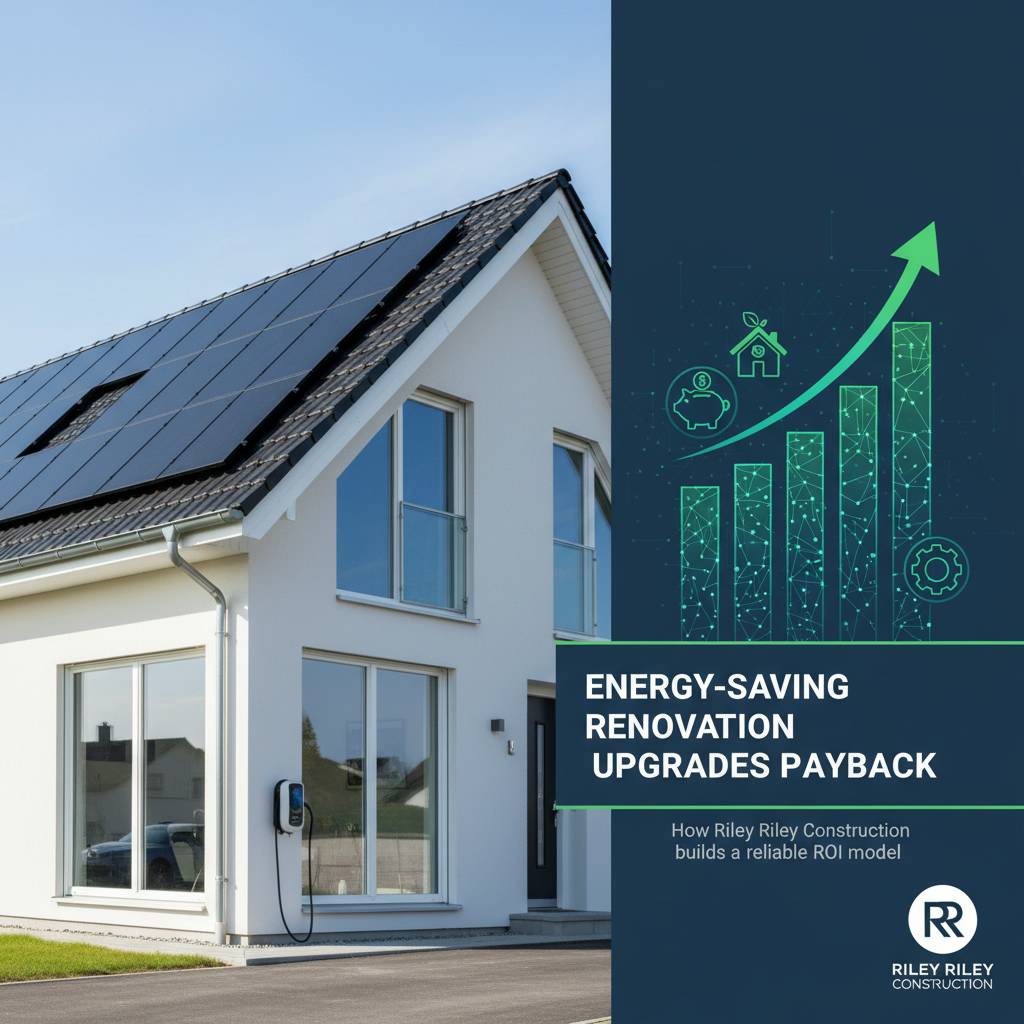 Riley Riley Construction begins by collecting building-specific data: utility bills, existing equipment efficiency, construction details, and occupancy patterns. From that baseline, we run physics-based and empirical models to estimate energy use after each proposed upgrade. Our modeling accounts for local climate, fuel prices, and interactive effects-so insulating the attic and replacing an aging furnace are evaluated together, not in isolation. That prevents double-counting savings and reveals true marginal benefits of each measure.
We present results in clear, comparable metrics: estimated annual energy savings, dollar savings per year, simple payback (years), and lifetime net savings. For commercial clients we also include cash flow diagrams and internal rate of return (IRR) where appropriate. Those outputs let decision-makers weigh capital expense against operational savings, confirm that investments meet corporate or homeowner thresholds, and qualify for available incentives with confidence.
Key upgrades that deliver reliable returns
Not all energy-saving renovation upgrades payback at the same pace. Some measures, like sealing air leaks or upgrading a high-efficiency furnace, typically return cost quickly, while aesthetic or low-energy-impact upgrades take longer to justify purely on energy savings. Below we describe the most common, high-impact measures-insulation, HVAC, windows, and efficient appliances-and the contexts in which they give fast, dependable payback.
Insulation and air sealing
Insulation and air sealing are often the most cost-effective first steps. They reduce heating and cooling demand by limiting heat flow through roofs, walls, and floors and by eliminating uncontrolled air leaks. Typical upgrades include adding attic insulation, dense-packing wall cavities, and sealing gaps around windows, doors, and mechanical penetrations. Because the physics are straightforward and the results immediate, savings estimates tend to be reliable and repeatable across similar homes and buildings.
When combined with a right-sized HVAC system, insulation upgrades can yield faster payback because the mechanical system runs less often and experiences less wear. Insulation work also improves occupant comfort and reduces humidity-related risks, translating to non-energy benefits that add tangible value over time.
Heating, ventilation, and air conditioning (HVAC)
Replacing aged HVAC equipment with high-efficiency models often produces strong returns-especially when older systems are oversized, poorly matched to the building, or past their expected service life. Modern heat pumps, condensing boilers, and variable-speed furnaces deliver higher seasonal efficiencies and better part-load performance. Correct equipment sizing, proper duct sealing, and smart controls are essential to realize modeled savings in the field.
Upgrading controls-thermostats, zoning, and commissioning-can yield a significant portion of HVAC-related savings at relatively low cost. These measures reduce runtime, remove inefficiencies, and tailor comfort to actual occupancy patterns, improving payback without replacing major equipment unless the existing system is failing or fundamentally inefficient.
Windows, shading, and glazing
Window upgrades often deliver mixed returns depending on the climate, existing window condition, and whether the replacement includes improved frames, low-e coatings, or gas fills. In heating-dominated climates, single-pane replacements are more likely to produce rapid energy payback. In moderate climates, window upgrades should be evaluated for additional benefits-comfort, condensation reduction, and noise control-that complement energy savings.
Adding exterior shading, interior blinds, or selective low-e coatings can improve performance without full replacement. Upgrades that reduce solar heat gain in summer or improve insulation in winter are particularly valuable when prioritized alongside envelope improvements and HVAC upgrades for a comprehensive strategy.
Efficient appliances and lighting
Appliance and lighting upgrades are some of the lowest-risk ways to achieve immediate savings. Replacing refrigerators, clothes dryers, water heaters, and incandescent lighting with ENERGY STAR-rated equipment reduces electricity and fuel use substantially with minimal installation complexity. Because these measures are typically low-cost, they often provide short payback periods and can be bundled to improve project economics.
Smart controls, demand management, and efficient hot water solutions (tankless or heat pump water heaters) further enhance savings and longevity. Appliances generally have well-defined performance ratings, which makes modeled savings more predictable and helps prioritize replacement on appliances that consume the most energy.
Comparing costs, savings, and payback: a practical table
Below is a concise comparison of common upgrades, typical installed cost ranges, expected annual energy savings, and rough simple payback periods. These numbers are directional and intended to help prioritize measures before running a site-specific model with Riley Riley Construction.
| Upgrade | Typical installed cost | Typical annual savings | Typical simple payback |
|---|---|---|---|
| Attic insulation and air sealing | $500-$3,000 | $150-$600 | 2-6 years |
| High-efficiency heat pump (split system) | $3,500-$10,000 | $400-$1,500 | 3-10 years |
| Window replacement (select units) | $300-$1,000 per window | $50-$300 per window | 5-20 years |
| LED lighting retrofit | $75-$200 per room | $30-$150 per room | 1-3 years |
| Heat pump water heater | $1,000-$3,500 | $300-$700 | 2-6 years |
These figures can vary substantially with fuel costs, local incentives, occupancy behavior, and climate. A modeled analysis from Riley Riley Construction replaces broad estimates with specific projections tailored to your property and goals.
How to prioritize measures for the fastest energy-saving renovation upgrades payback
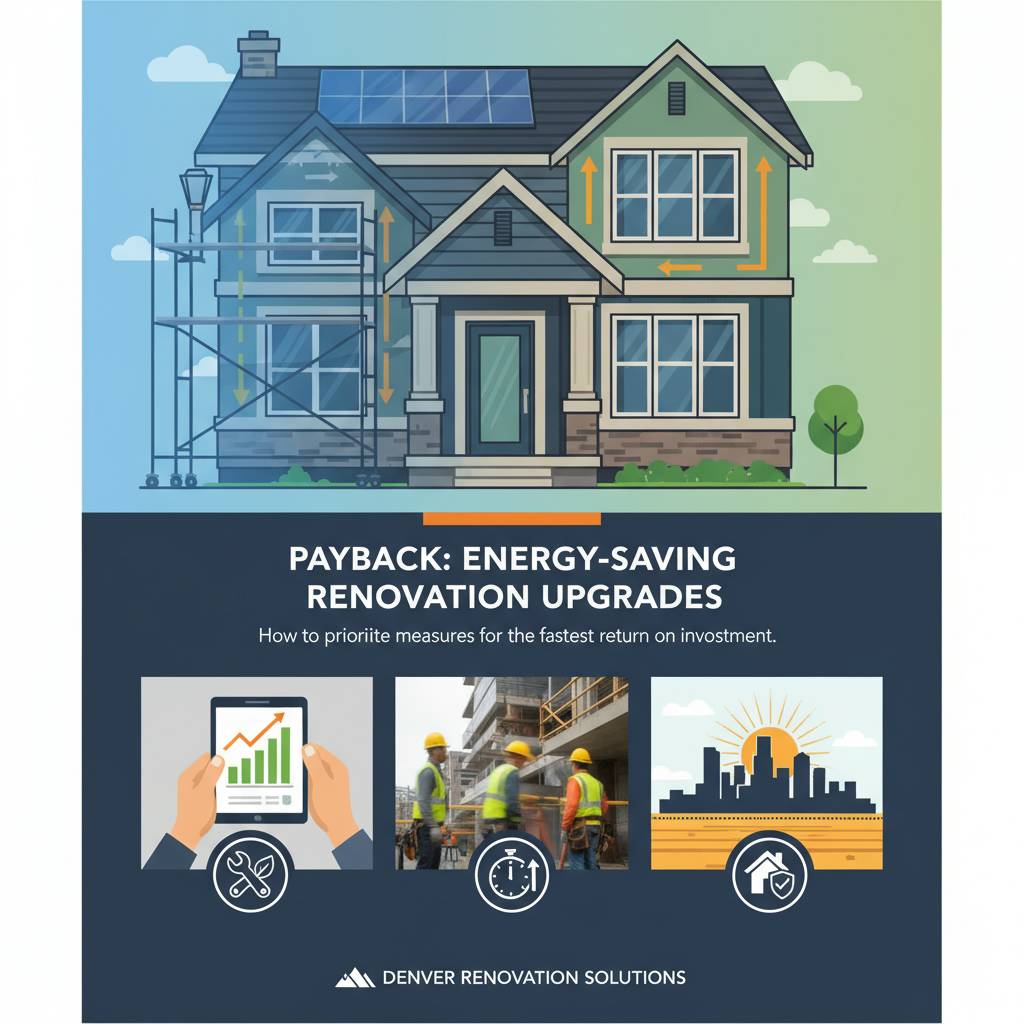 Start with no-regret measures that reduce demand cheaply-air sealing, insulation, thermostatic controls, and LED lighting. These measures lower the scale of necessary mechanical upgrades and often produce the shortest payback times. Next, evaluate mechanical systems that have reached end-of-life or perform poorly; replacing an inefficient furnace or adding a modern heat pump typically complements envelope work and accelerates combined savings.
Sequence matters. Implement envelope improvements before upsizing or replacing HVAC equipment so the new system is sized correctly and operates efficiently. When you bundle measures into a single project, you also reduce mobilization costs and can sometimes qualify for larger incentives, improving overall project economics and shortening payback periods.
Implementation steps: from assessment to verified savings
Executing an energy-saving renovation with reliable payback requires a structured process. Begin with a thorough assessment: utility bill analysis, a walk-through inspection, and baseline energy modeling. Next, prioritize measures based on modeled payback and non-energy benefits, then develop a phased or full-scope plan that aligns with budget and occupancy constraints. During implementation, quality control and commissioning ensure that installed measures perform as modeled-correct ductwork, calibrated thermostats, and verified insulation levels are common performance checks.
Finally, follow up with post-installation measurement and verification. Capturing actual energy use and comparing it to the model closes the loop, builds confidence, and informs future decisions. Riley Riley Construction can assist through every phase-assessment, design, contractor selection, and post-install verification-to make sure energy-saving renovation upgrades payback projections become realized savings.
- Step 1: Baseline analysis and utility bill review.
- Step 2: On-site inspection and diagnostic testing (blower door, thermography).
- Step 3: Modeled scenarios and prioritized measure list.
- Step 4: Implementation with quality assurance and commissioning.
- Step 5: Post-installation monitoring and verification.
Financing, incentives, and cost-reduction strategies
Financing and incentives can dramatically change the payback math. Federal, state, and local rebate programs, tax credits, and utility incentives often reduce upfront costs for efficient equipment and envelope upgrades. Low-interest financing, on-bill repayment, and energy-efficiency loans allow owners to spread capital costs while capturing energy savings that help repay the loan. Riley Riley Construction maintains an up-to-date library of local and national incentives to include in your modeled ROI so you can see the net cost and revised payback.
Consider leveraging performance contracts for larger commercial projects or bundling smaller residential measures into one retrofit to reduce contractor mobilization fees. Prioritize measures that unlock incentives-such as heat pumps, EV chargers, and whole-home air sealing-so you get the most support for the highest-impact upgrades. Proper documentation and pre-approval through incentive programs ensure you receive rebates after successful installation and verification.
Real-world examples and short case studies
Case study 1: A three-bedroom suburban home retrofitted with attic insulation, air sealing, LED lighting, and a new heat pump saw modeled energy reductions of 35% with a portfolio payback of 5.8 years. After work was complete and verified, the homeowner reported both the modeled energy savings and improved comfort, with peak winter runtime reduced significantly and monthly bills declining in line with projections. Incentives reduced the net cost by 18% and improved the effective payback timeframe.
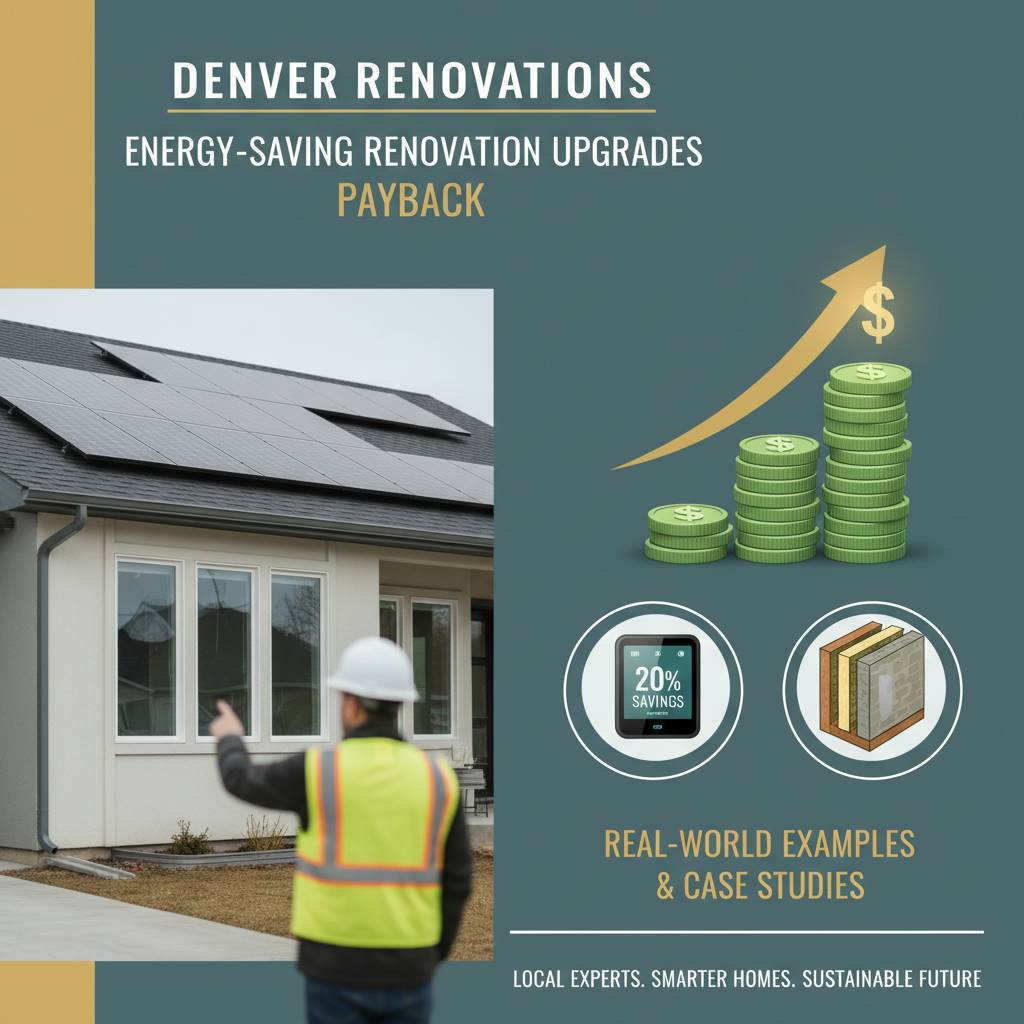
Case study 2: A small office building replaced old windows and upgraded HVAC controls without changing the boiler. The measures were modeled together to avoid overestimating benefits, and the combined project produced a 20% energy reduction and a simple payback of 4 years. The building owner used a short-term loan to cover costs and applied energy savings directly to loan payments, achieving net positive cash flow in month 14 after installation.
Frequently asked questions
How accurate are modeled payback estimates? Models are as accurate as the inputs. When they use actual utility bills, measured building characteristics, and local climate data, modeled payback becomes a reliable planning tool. Riley Riley Construction emphasizes conservative assumptions and includes sensitivity ranges so clients see best-case, expected, and conservative scenarios.
Do non-energy benefits matter? Absolutely. Comfort, indoor air quality, reduced maintenance, and improved property value are important considerations. While these benefits are sometimes difficult to quantify precisely, they often tip the balance in favor of measures with modest energy returns but significant qualitative upside. We include these factors in our recommendations where they materially affect decision-making.
Next steps and a short call to action
If you are considering upgrades or a whole-house or whole-building retrofit, start with a no-surprise assessment from Riley Riley Construction. We translate your utility history, building specifics, and goals into a prioritized plan showing which energy-saving renovation upgrades payback fastest and where to allocate capital for the best return. Our approach is practical, transparent, and focused on measurable results.
To schedule a customized payback analysis, contact Riley Riley Construction at 17209155352. We will walk you through the assessment process, available incentives, and a clear timeline for implementation so you can make an informed, data-driven decision about energy investments that improve comfort and reduce ongoing costs.
Whether you are renovating a single-family home, managing a portfolio of buildings, or planning a phased upgrade over several years, Riley Riley Construction can help you prioritize measures, maximize incentives, and verify savings. Call us at 17209155352 to get started with a tailored ROI model and a roadmap for reliable energy savings and improved building performance.