
Cost-Benefit Of Full Versus Partial Remodel
Deciding Between a Full and Partial Remodel: An Overview
Choosing whether to pursue a full or partial remodel is one of the most important decisions a homeowner can make when planning an update. The cost-benefit of full versus partial remodel projects depends on multiple variables: existing conditions, desired outcomes, market expectations, and long-term lifecycle costs. Riley Riley Construction helps homeowners quantify long-term value by weighing disruption, resale impact, and ongoing maintenance against upfront expenditures so you can align scope with priorities and budget.
In this guide we walk through practical considerations that influence scope decisions, present a comparison framework, and outline next steps to help you make an informed choice. If you prefer a quick reality check, a brief consultation with Riley Riley Construction will give you a clearer sense of trade-offs tailored to your property and neighborhood context.
Understanding Project Scope and Level of Disruption
The scope of work directly determines the level of disruption to daily life. A full remodel typically involves structural modifications, systems upgrades (HVAC, electrical, plumbing), and comprehensive finishes throughout multiple rooms. That naturally extends project duration and increases interruptions. Partial remodels-such as updating a kitchen, bathroom, or adding new flooring in sections-are less disruptive and often allow homeowners to remain in their homes during construction.
Disruption isn't limited to noise and temporary relocation. There are indirect costs to consider: meals out during kitchen renovation, temporary storage for furniture, and the mental overhead of living through construction. Assign realistic values to these non-construction costs when comparing options. For many households, lower disruption has tangible value that may justify choosing a partial remodel even if the cost per square foot is higher.
Typical timelines and what they mean
- Full remodel: generally 8-20 weeks depending on structural work and permitting; expect intermittent subcontractor overlap and potential schedule shifts.
- Partial remodel: often 2-8 weeks for a kitchen or bathroom refresh, with more predictable scheduling and fewer unknowns.
- Minor updates: 1-2 weeks for cosmetic improvements such as paint, hardware, or lighting swaps.
Resale Impact and Market Considerations
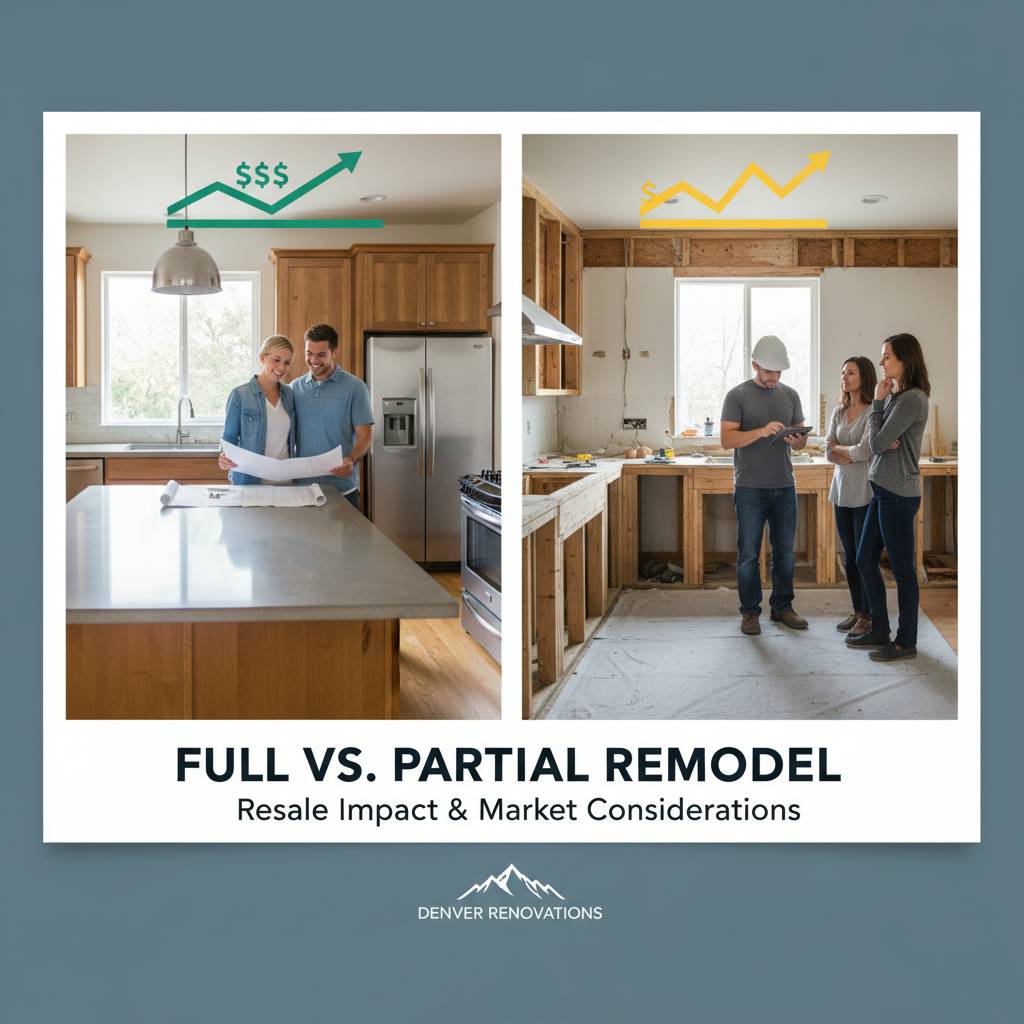 When planning a remodel, align scope with local market expectations. In neighborhoods where buyers expect modern systems and open-plan living, a full remodel can unlock a higher resale price and faster sale. Conversely, in markets with conservative buyer profiles or older historic homes, over-improving can result in limited payback-buyers may not value high-end finishes as much as you do.
Consider the principle of right-sizing improvements: match the level of finish and systems upgrade to comparable homes in your area. Riley Riley Construction uses recent local comps and buyer preferences to estimate how much value each level of remodel is likely to capture. For example, a modestly upgraded kitchen often yields higher return on investment in many markets than a complete high-end refit that prices the home above neighborhood norms.
What buyers typically prioritize
- Reliable, modern systems (HVAC, roof, windows) often attract more buyer confidence than luxury surface finishes alone.
- Functional layouts and good flow can be more important than expensive materials-buyers value usability.
- Energy efficiency and low-maintenance materials increasingly influence purchase decisions and perceived long-term value.
Lifecycle Costs: Not Just Upfront Price
Decisions should account for lifecycle costs-not just the initial construction price. A full remodel allows you to replace aging mechanical systems, improve insulation, and choose durable materials that reduce operating costs for years. Over a 10-15 year horizon, lower utility bills, fewer repairs, and less frequent replacements can make a full remodel more cost-effective than multiple smaller updates performed over time.
Partial remodels can be economical in the short term but may leave underlying systems unchanged, creating recurring maintenance expenses. For instance, a new kitchen without addressing an aging water supply or old wiring can mean plumbing leaks or electrical work later. Evaluate the interaction between cosmetic upgrades and technical debt; clearing that debt often requires a larger scope but yields lasting savings.
Example lifecycle comparisons
| Item | Partial Upgrade | Full Remodel |
|---|---|---|
| Kitchen cabinets and countertops | New cabinets, old plumbing/electrical left in place | New cabinets plus full systems replacement |
| Mechanical systems | Unchanged, likely repairs within 5-10 years | Replaced for 15-25 year reliability |
| Energy and maintenance | Modest improvement; recurring costs | Significant reductions in utility and repair costs |
Financial Modeling: Cost-Benefit of Full Versus Partial Remodel
An effective cost-benefit analysis converts qualitative factors into quantifiable metrics. Start by listing upfront costs, expected life of improvements, estimated annual savings (energy, maintenance), and projected resale premium. Apply a simple payback or net-present-value approach to compare scenarios. For many homeowners the math clarifies whether a full remodel delivers sufficient long-term value.
Typical cost ranges help set expectations. For instance, mid-range kitchen remodels commonly run $50,000-$120,000 depending on size and appliances, while full-home remodels can be $75-$200 per square foot for moderate upgrades and higher for premium finishes. Use these ranges as starting points and refine estimates with local cost inputs from contractors and supplier quotes.
- Estimate immediate outlay: contractor bids, permits, design fees, contingency (typically 10%-20%).
- Estimate operating savings: energy efficiency, fewer repairs, lower replacement frequency.
- Estimate resale uplift: consult local comps and agent input for realistic appreciation of upgrades.
When comparing the cost-benefit of full versus partial remodel scenarios, include a sensitivity analysis: test optimistic, realistic, and conservative assumptions about resale capture and cost overruns. This reveals which option is robust across different outcomes and helps avoid surprises.
Practical Decision Framework
 Use a simple decision matrix to weigh factors: homeowner goals, budget, timeline, market alignment, and lifecycle implications. Prioritize non-negotiables (safety upgrades, structural fixes, or system failures) that justify broader work. Next, rank desirable outcomes (open plan, high-end finishes, energy efficiency) to see which scope best accomplishes the most priorities for the least cost or disruption.
For many homeowners, a staged approach works well: address critical system needs first in a focused partial remodel, then plan cosmetic upgrades in a second phase. This reduces immediate financing requirements and spreads disruption, but it may cost more in total due to repeated mobilization and potential design mismatches. can advise when staging makes sense versus when a single comprehensive project saves money and time.
Checklist to apply now
- Identify urgent repairs that cannot be deferred without added risk or cost.
- Compare expected life spans: will a partial fix require replacement again within 5 years?
- Get at least two contractor estimates and a market-value assessment from a real estate pro.
- Factor in disruption costs and personal tolerance for living through construction.
Case Studies and Examples
Consider two illustrative examples. Homeowner A had an older bungalow with outdated plumbing and an inefficient HVAC system. They chose a full remodel that replaced systems and reconfigured the first floor. Upfront costs were higher, but energy bills dropped and the property sold for 18% above comps two years later. The full remodel captured significant resale uplift due to system modernization and improved layout.
Homeowner B needed only a functional refresh to improve living comfort and planned to remain in the home long-term. They chose a partial remodel-new kitchen surfaces, updated fixtures, and selected appliances-while leaving major systems in place. The project cost less and minimized disruption, meeting their immediate goals. However, they budgeted for mechanical updates in 5-7 years, accepting some future expense in trade for present comfort and lower short-term cost.
Making the Final Call and Next Steps
Deciding between a full and partial remodel comes down to aligning the project with your timeline, financial capacity, and long-term goals. If you aim to maximize resale value and eliminate technical debt, a well-executed full remodel often produces the best lifecycle outcomes. If minimizing disruption and immediate cash outflow is paramount, a targeted partial remodel can deliver meaningful improvements with lower short-term commitment.
Riley Riley Construction provides tailored evaluations that quantify the cost-benefit of full versus partial remodel options for your specific property. We analyze local market comparables, estimate lifecycle savings, and model likely resale capture so you can choose a scope that supports your objectives. For a clear, customized assessment, reach out to us for a site consultation.
Calls to Action
If you're planning a remodel and want a professional cost-benefit analysis tailored to your home, contact Riley Riley Construction for a detailed evaluation. We'll help you compare disruption, resale impact, and lifecycle costs to determine the optimal scope.

Schedule a consultation today by calling 17209155352 or requesting a callback online. Small differences in scope can have large long-term consequences-let us help you make the choice that maximizes return while minimizing unnecessary expense.
We look forward to helping you make an informed, practical decision. Contact Riley Riley Construction at 17209155352 for a tailored evaluation that matches your goals and budget.